

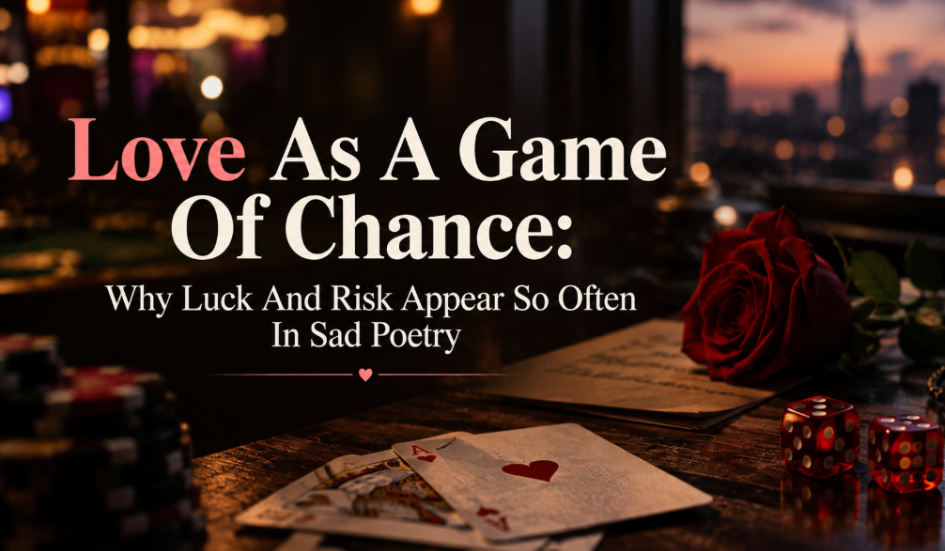
Love rarely comes with a clear map.
Two people can meet at the right moment yet want different things. A strong bond can grow from an accidental meeting. A relationship that once felt certain can change without warning. This uncertainty gives poets a natural link between love and chance.
Sad poetry often turns that link into simple, physical images.
A heart becomes a card placed on the table. Trust becomes a risk. Meeting someone feels like good fortune.
Losing them feels like luck suddenly turning in another direction.
These images work because readers already understand uncertainty. They know what it means to hope for one result while knowing another may arrive.
Yet the strongest poems are not really about games or probability. They are about emotional risk.
To love someone means accepting that the future cannot be guaranteed. Affection may be returned or rejected. A promise may last or break. A relationship may grow or fade.
Sad poetry takes that uncertainty and gives it a shape.
Luck describes what people cannot control. Risk describes what they choose despite that uncertainty. Together, these ideas give poets a compact language for love, hope, separation, and heartbreak.
Chance Gives Poets A Concrete Language For Uncertain Love
Love can feel certain one day and fragile the next. Sad poetry turns that uncertainty into images readers can grasp at once.
A poet may describe affection as a card drawn from a hidden deck, a coin still in the air, or a road chosen without knowing where it ends. Each image turns an unclear emotion into something physical.
This language also appears in modern culture. A phrase such as desi bet, for example, carries an immediate association with chance and uncertain outcomes. In poetry, the same idea can work as a metaphor for placing trust in another person without knowing what the relationship will become.
That uncertainty gives sad verse much of its tension.
The speaker hopes for one outcome but fears another. Love may grow, fade, or remain unanswered. No promise can remove every unknown.
Chance gives this emotional risk a simple shape.
Instead of explaining uncertainty in abstract terms, poetry lets readers picture the moment before a result becomes known. That image captures a central part of vulnerable love: hope exists precisely because the ending remains uncertain.
Risk Turns Love Into An Emotional Choice
Chance describes what lovers cannot control. Risk describes what they choose to do anyway.
A person can share a secret, admit affection, or trust someone with a painful memory. Each act creates uncertainty. The other person may respond with warmth, silence, or rejection.
Sad poetry often focuses on this moment because it exposes vulnerability.
A closed heart feels safe but distant. An open heart creates the possibility of connection and pain at the same time. The image is simple, yet it captures why romantic risk carries such emotional weight.
Poets can make this tension physical. A confession becomes a step across a narrow bridge. Trust becomes a door left unlocked. Hope becomes a hand reaching into the dark.
These images make emotional choices easier to feel.
The sadness becomes stronger when the reader knows that the speaker chose hope despite uncertainty. Heartbreak then represents more than a bad outcome. It becomes the consequence of having trusted another person with something valuable.
That is why risk appears so naturally in sad poetry. It gives love a cost before the ending is known.
Luck Gives Heartbreak A Simple Explanation
After love ends, people often search for a clear reason.
Sometimes they find one. A promise was broken. Distance grew. Priorities changed. In other cases, no single cause explains the loss. The relationship simply reached the wrong moment.
Sad poetry often uses luck and fate to describe this gap.
A poet may write about meeting the right person at the wrong time. Another may describe happiness as something that arrived briefly and then slipped away. These images turn a complex breakup into a simple contrast between what was hoped for and what happened.
Luck also helps poets express a lack of control.
Someone can offer care, time, and trust without controlling another person’s feelings. That limit makes heartbreak difficult. Effort does not guarantee a certain emotional result.
Poetry captures this tension well.
Bad luck becomes shorthand for the distance between desire and reality. It does not need to explain every detail of the relationship. Instead, it gives the reader a familiar frame for understanding why sincere hope can still end in disappointment.
Fate Gives Separation A Larger Meaning
Sad poetry often treats separation as more than a simple ending.
Two people may care for each other yet still move apart. Distance, timing, family, work, or changing goals can reshape a relationship. When no single person caused the loss, poets often turn to fate.
Fate gives the separation a larger frame.
A missed meeting becomes a road that never crossed again. A late confession becomes a door that closed seconds too soon. Two people can seem right for each other while life keeps placing obstacles between them.
These images work because they combine love with helplessness.
The speaker may know what they want but cannot control every condition around them. That tension creates a specific kind of sadness. The relationship did not fail because affection was absent. It failed because circumstances changed what was possible.
Fate gives poets a way to describe love that feels real but cannot continue.
This idea fits sad poetry especially well. It allows the poem to hold two truths at once: the connection mattered, yet wanting it was not enough to guarantee that it would last.
Games Of Chance Give Loss A Physical Shape
Sad poetry often works best when an emotion becomes something the reader can picture.
Loss can feel vague when described on its own. A poet can make it sharper by comparing it with an uncertain game, a losing hand, or a final turn that changes everything. The image gives heartbreak edges and weight.
This is why chance metaphors remain useful.
A relationship may begin with hope. Both people make choices, take emotional risks, and imagine a shared future. Yet the result can still differ from what either person expected.
The metaphor becomes especially strong after separation.
A losing hand cannot be replayed. A coin that has landed no longer carries two possible outcomes. In the same way, a finished relationship turns hope into memory.
These images make loss easier to express without long explanations.
They also capture an important contrast in sad poetry: the past once contained many possible futures, but the present contains only what actually happened.
That shift from possibility to certainty gives heartbreak much of its emotional force.
Sad Poetry Turns Winning And Losing Into Emotional Metaphors
Love poetry often borrows the language of winning and losing because the contrast is immediate.
A relationship that begins well can feel like unexpected good fortune. When it ends, the same speaker may describe the experience as a loss. The words are simple, but they carry emotional weight.
Sad poetry can also reverse the usual meaning of victory.
A person may “win” an argument but lose the relationship. Someone may finally hear the truth yet wish they had never learned it. Another person may get the freedom they wanted and then discover that freedom feels empty.
These contrasts give poets useful material.
Winning and losing also show how perspective changes after heartbreak. A memory that once felt precious may later hurt. A risk that once seemed worthwhile may look different after separation.
The outcome changes how the past is understood.
That is why these metaphors fit sad poetry so naturally. They compress a complicated emotional journey into familiar terms. The poem does not need to explain every stage of the relationship. A simple contrast between hope and loss can carry much of the story.
Chance And Risk Make Heartbreak Feel Universal
Sad poetry lasts because its core emotions cross cultures and generations.
People may speak different languages or follow different traditions, yet uncertain love remains familiar. Almost anyone can understand the fear of losing someone, the hope of being loved back, or the pain of bad timing.
Chance gives poets a simple way to connect these experiences.
Luck represents what cannot be planned. Risk represents the choice to care despite uncertainty. Fate describes events that seem larger than personal control. Loss shows what remains when hope meets a different outcome.
Together, these ideas create a compact emotional language.
A poem does not need to explain every detail of a relationship. One image of a missed chance, an unlucky turn, or a risk that failed can suggest an entire story.
Love feels like a game of chance in poetry because its outcome can never be fully guaranteed.
That uncertainty gives sad verse much of its power. The reader recognizes both sides at once: the hope that made love worth pursuing and the possibility of loss that was present from the start.
